Showing posts with label snakes. Show all posts

Tuesday, June 26, 2012

How to kill Garden Slugs:


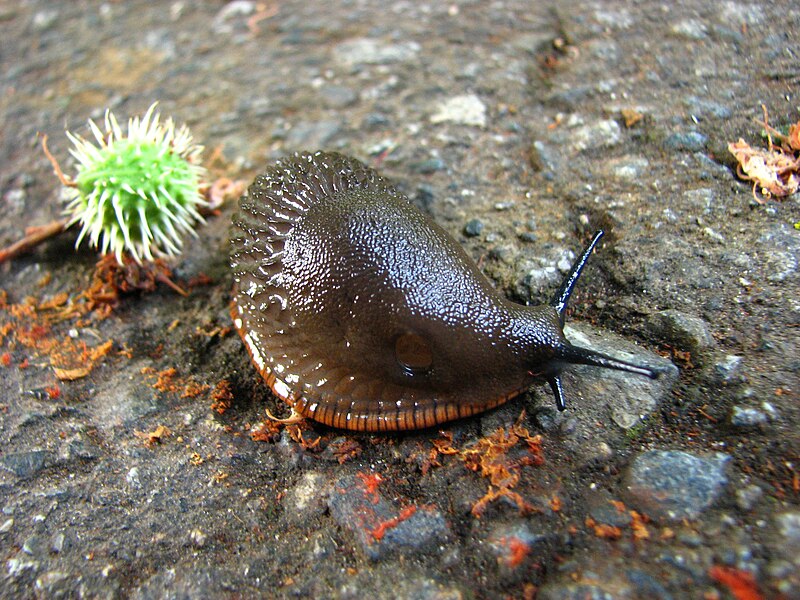
An unidentified slug in Vancouver, British Columbia
Photo by Magnus Mansk


The garden slug a mighty fellow is he; if you’re not careful he’ll eat your whole garden.  Yet getting rid of these pests is easy to accomplish.  All they really are is a snail without a shell.  There are many different ways to attack these varmints that are organic and safe.

One of the most effective ways to get these critters is with nothing more simple then a saltshaker.  You can go slug hunting after it gets dark with a flashlight in one hand and a salt shaker in the other.  Slugs will immediately dissolve into nothing when a little salt is sprinkled upon them.  Try it and see!

Another way to get rid of these pests is to get them drunk on beer.  Use the twist-off lid from a jar and place it in your garden where slugs are feeding.  The beer acts as an attraction for slugs.  When they crawl into the lid full of beer the action of the alcohol in the beer also causes the slugs to dissolve.  The next morning if you don’t find the lid full of dead slugs or you will find you have a drunken raccoon on your hands.  A drunken raccoon can be pretty amusing in their own right. 

The watermelon way of getting rid of slugs can also be used and is quite effective.  This is especially so if you want to catch as many slugs as you can without exerting yourself.  After eating out the melon you are left with the rind.  Place the rind face down on the ground in your garden.  During the night the slugs will come for a feast, and the next morning they will all be on the face down melon rind.  Then you can catch them and dispose of them at your leisure.  Sometimes your friendly local raccoon will get to the slugs before you do having a fine breakfast of slugs.  This takes the execution of the slugs from your hands.

Instead of throwing away the dirty dishwater you can also use this waste product as another effective way to deal with slugs.  It seems that a weak solution of soapy water will also do these pests in by causing them to once again dissolve.

Kitty Litter is another way to get rid of these pests.  All Kitty Litter really is, is diatomaceous earth.  If you sprinkle this around in your garden it will also suck the water from the body of the slug the same way that salt does.

Another friendly animal that feeds on slugs is your friendly local snake.  Just don’t expect results if the poor fellow is plum tuckered out from supplying bites to people who only drink when they have suffered snakebite.

References:


Tuesday, June 19, 2012

Food to eat for Survival


Huhu grubs in rotten pine wood
Photo by Charlotte Symmonds


One of the things you learn in Survival School is that you had better not be squeamish because you will learn to eat some of the damndest things that have ever passed a human’s front teeth.  For starters, what would you think about eating a big fat grub?

Believe me you’ll think about that for a while before chowing down, and that is only the beginning.  By the time you get out of the school you’ll learn to eat anything that doesn’t try to eat you first.  As a matter of fact poisonous snakes don’t make bad fare as long as you get them first.  Contrary to popular belief they don’t taste like chicken either; more like snake.  The ones we ate were Eastern Diamondback Rattlesnakes, not bad when cut up into short segments and roasted on the end of a sharpened stick over an open fire.  But first you have to skin the snake, and they don’t die right away.  Neither does the snake’s head, so after decapitating the snake carefully bury its head deeply as it still is capable of delivering a lethal bite for several hours after being severed from the rest of the snake.  The rest of the snake is completely harmless, but full of bones.  The way we cooked it, it tasted slightly smoky from the smoke of our cooking fire.

Snake wasn’t the only strange thing we ate however, roasted alligator tail was another.  For the benefit of the curious we were in the Florida Everglades.  Alligator isn’t bad, but it needs to be tenderized before eating or it will be like gnawing on the front tire of a Payloader.  The way to tenderize one is to cut the tail into steaks about one half of an inch thick and then pound them with a length of wood until they are tender.  This is the same way that Californians deal with the abalone, a type of shellfish found off the West Coast of the US.

In the survival school you are taught to eat many things that you normally wouldn’t give house room too, such as grubs, insects, spiders, and just about anything else that wasn’t poisonous to your digestive system.  Among the more entertaining things that were used as a demonstration product was “muktuk,” this gastronomical treat is a chunk of whale blubber and skin that you could chew for energy.  This is usually eaten by the Inuit, the natives of Arctic regions.  It tasted like a cross between oil soaked cotton batten, which was the blubber.  The skin was more like a piece of old tire.  Obviously, the tire tasted better.

Generally, the diet was pretty high in protein, but there were some simple vegetable item added for variety.  One of these was quite interesting as it was the cambium layer from a tree.  This is the thin layer found just under the bark.  It is light in color, and to prepare it too eat you have to cut it into very thin strips before cooking.  You cook it by boiling it in hot water for several minutes, and eat it like spaghetti.  It isn’t very nutritious but it will provide enough calories to take the edge off hunger.

Another edible that we took advantage of in the Everglades was palm hearts.  This was the bud found at the top of a palm tree.  There are so many plants in the Everglades that this was about the only vegetation we dared eat.  I guess it is true that there are over 500 ways that you can die in the Everglades.

Another thing we learned was not to eat too many rabbits because although they are easy to catch the rabbit lacks body fat that we need to survive.  Rabbits are high in protein, but require that you find another source of fat to go with them, or you will starve to death in the midst of plenty.

From survival school the author determined that if someone wasn’t shooting at him the most likely place to survive is to head for a coastline of the ocean because there are so many things that you can scavenge from the ocean that you would never starve, and probably would be able to live a good life even though it is restricted.