Showing posts with label food. Show all posts

Tuesday, June 19, 2012

Food to eat for Survival


Huhu grubs in rotten pine wood
Photo by Charlotte Symmonds


One of the things you learn in Survival School is that you had better not be squeamish because you will learn to eat some of the damndest things that have ever passed a human’s front teeth.  For starters, what would you think about eating a big fat grub?

Believe me you’ll think about that for a while before chowing down, and that is only the beginning.  By the time you get out of the school you’ll learn to eat anything that doesn’t try to eat you first.  As a matter of fact poisonous snakes don’t make bad fare as long as you get them first.  Contrary to popular belief they don’t taste like chicken either; more like snake.  The ones we ate were Eastern Diamondback Rattlesnakes, not bad when cut up into short segments and roasted on the end of a sharpened stick over an open fire.  But first you have to skin the snake, and they don’t die right away.  Neither does the snake’s head, so after decapitating the snake carefully bury its head deeply as it still is capable of delivering a lethal bite for several hours after being severed from the rest of the snake.  The rest of the snake is completely harmless, but full of bones.  The way we cooked it, it tasted slightly smoky from the smoke of our cooking fire.

Snake wasn’t the only strange thing we ate however, roasted alligator tail was another.  For the benefit of the curious we were in the Florida Everglades.  Alligator isn’t bad, but it needs to be tenderized before eating or it will be like gnawing on the front tire of a Payloader.  The way to tenderize one is to cut the tail into steaks about one half of an inch thick and then pound them with a length of wood until they are tender.  This is the same way that Californians deal with the abalone, a type of shellfish found off the West Coast of the US.

In the survival school you are taught to eat many things that you normally wouldn’t give house room too, such as grubs, insects, spiders, and just about anything else that wasn’t poisonous to your digestive system.  Among the more entertaining things that were used as a demonstration product was “muktuk,” this gastronomical treat is a chunk of whale blubber and skin that you could chew for energy.  This is usually eaten by the Inuit, the natives of Arctic regions.  It tasted like a cross between oil soaked cotton batten, which was the blubber.  The skin was more like a piece of old tire.  Obviously, the tire tasted better.

Generally, the diet was pretty high in protein, but there were some simple vegetable item added for variety.  One of these was quite interesting as it was the cambium layer from a tree.  This is the thin layer found just under the bark.  It is light in color, and to prepare it too eat you have to cut it into very thin strips before cooking.  You cook it by boiling it in hot water for several minutes, and eat it like spaghetti.  It isn’t very nutritious but it will provide enough calories to take the edge off hunger.

Another edible that we took advantage of in the Everglades was palm hearts.  This was the bud found at the top of a palm tree.  There are so many plants in the Everglades that this was about the only vegetation we dared eat.  I guess it is true that there are over 500 ways that you can die in the Everglades.

Another thing we learned was not to eat too many rabbits because although they are easy to catch the rabbit lacks body fat that we need to survive.  Rabbits are high in protein, but require that you find another source of fat to go with them, or you will starve to death in the midst of plenty.

From survival school the author determined that if someone wasn’t shooting at him the most likely place to survive is to head for a coastline of the ocean because there are so many things that you can scavenge from the ocean that you would never starve, and probably would be able to live a good life even though it is restricted.

Making Pemmican the Indian Way


Cree Indian in the old days


Pemmican was derived from its use as an emergency food by the Cree Indians in Canada.  It is made by preparing strips of game meat such as bison, moose or venison by drying them either in the sun or before a campfire until they were hard.  The meat was then pounded into a powder using stones, and mixed 50/50% with fat from the animal.  A mixture of berries was pounded into the pemmican for additional flavor and added nutrition.  Ordinary pemmican was made from dried buffalo meat and fat.  By adding berries to the pemmican it was more apt to spoil.  Ordinary pemmican however was still edible after as much as 30 years.

The Métis central Canada native people who made their living trapping eventually became the biggest suppliers of pemmican.  They supplied it to the Canadian government the Hudson Bay Company, the US government and anyone else that bought the stuff.  Making pemmican was actually a work for the women of the group.  They used to cut the lean buffalo meat into strips about a quarter of an inch thick and hang on a rack made out of willow twig bows that were interlocked in such a way as to form a framework.  The buffalo meat was hung in this rack and was either dried by the hot sun or place close to an open flame.  The finished product of this step we’re all familiar with as jerked beef.  It was dry and hard.  The womenfolk pounded it into a powder between two stones.  When the meat is thoroughly powdered it was placed in a kettle and an equal volume of hot water was added.  This was thoroughly stirred together with the powdered meat forming ordinary pemmican.  They then poured it into rawhide sacks for storage.  While the mixture was in the sack and still hot they trod on it with their feet in order to flatten the pemmican into a slab for later use.  If they were going to make what was called festive pemmican they added fruits and berries, but this kind of pemmican did not have been keeping qualities of ordinary pemmican.

Monday, June 18, 2012

The History of Food Chemistry


Filled tomatoes
Photo by Dnor


Food chemistry's history dates back as far as the late 18th century when many famous chemists were involved in discovering chemicals important in foods, including Carl Wilhelm Scheele (isolated malic acid from apples in 1785), and Sir Humphry Davy published the first ever book on agricultural and food chemistry in 1813 titled Elements of Agricultural Chemistry, in a Course of Lectures for the Board of Agriculture in theUnited Kingdom which would serve as a foundation for the profession worldwide, going into a fifth edition.
In 1874 the Society of Public Analysts was formed, with the aim of applying analytical methods to the benefit of the public[1]. Its early experiments were based on bread, milk and wine.
It was also out of concern for the quality of the food supply, mainly food adulteration and contamination issues that would first stem from intentional contamination to later with chemical food additives by the 1950s. The development of colleges and universities worldwide, most notably in the United States, would expand food chemistry as well with research of the dietary substances, most notably the Single-grain experiment during 1907-11. Additional research byHarvey W. Wiley at the United States Department of Agriculture during the late 19th century would play a key factor in the creation of the United States Food and Drug Administration in 1906. The American Chemical Society would establish their Agricultural and Food Chemistry Division in 1908 while the Institute of Food Technologists would establish their Food Chemistry Division in 1995.

How to make Chinese Steamed Food:


Dim sum in a Chinese Steamer
Photo by Young


Steaming Chinese food is the least invasive to the ingredients of all methods of Chinese Cooking.  This is a method of cooking with steam rather then by boiling water.  Steam is capable of cooking any food.  It starts with a wok full of boiling water and a set of nifty Chinese steamers.  These are stacking circular baskets made of bamboo or stainless steel that are available in most kitchen supply stores or Chinese supermarkets.  They have woven bamboo bottoms to allow the steam to pass through.  It is important though to place a paper towel over their bottoms so that the food will not stick to the bamboo.  Steamed food whether it is vegetable, fruit, fish or meat is tender and because it is steamed retains most of its nutrients.  Steaming can be used on portions of meals or can be made to create an entire meal.

As in all techniques of Chinese cooking it is important that you segregate the ingredients by density placing the more dense ingredients at the bottom of a stack of steamers.  At the same time the ingredients have to be cut into uniform bite sized pieces so that they will cook evenly.

Some modern micro-wave ovens include a way to cook food by steaming providing a separate vessel to hold the water so that the water never comes into contact with the food only steam.  This technique is perfectly suited to the traditional Chinese steaming and may be substituted in its place.  The food that is steamed gives the dishes a moist texture, and for the health conscious there is no oil involved giving added calories.

It is also the simplest technique to master as it is almost impossible to either overcook or burn the ingredients when steaming them.  Using the steaming method also gives a more nutritious food because the vitamins and minerals are not leached away as they are by boiling the food as is common with Western cooking methods.  Steaming reduces vitamin C by 15% whereas boiling will reduce it by 25%.  All of the other nutrients are reduced by the same amount whatever method is used for cooking.  The only real disadvantage to steaming is that it is the least efficient of any of the cooking methods because most of the energy is lost to the low-efficient water that is making steam.

In Western cooking the steaming technique is usually reserved for vegetables whereas in Chinese cooking it is usually the fish, shellfish or meat that is steamed.  A steamed meat dish in most Chinese restaurants is a rarity though because it is more efficient to stir fry them, besides that the Westerners won’t know the difference.

Sunday, June 17, 2012

Campfire Cooking


Campfire dinner
Photo by Daniel Ottman


There are several methods of doing this the simplest is just sticking your food onto the end of a sharpened stick and holding it to the flames.  This is okay if you are only cooking small pieces of food, but anything bigger you will have to discover other means.  The handheld broilers made out of green twigs that are held above the flames are another method that we have described in another article is another.

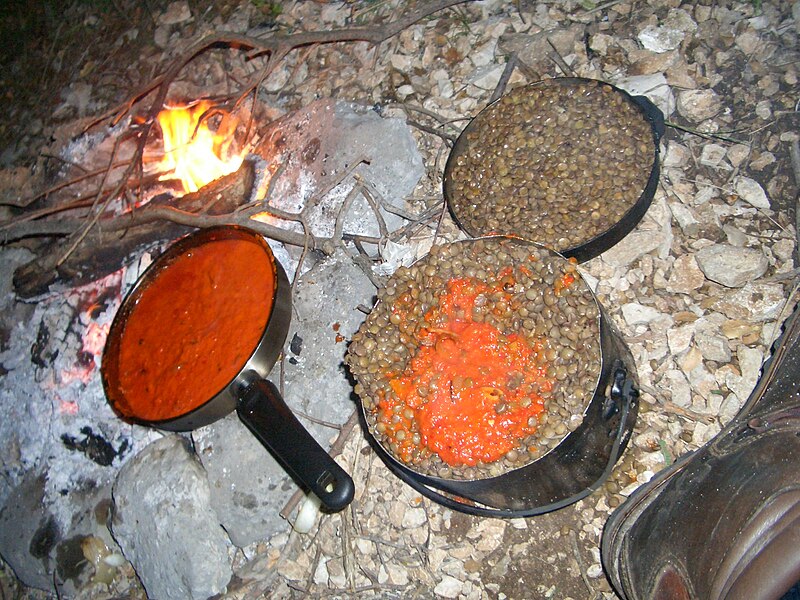
A lot of camp cooking consists of various soups and stews that require an entirely different approach to the cooking style.  They are made by boiling the meal in a pot.  Putting a pot over a campfire is another proposition. 

The first thing you don’t want to happen is for your food to accidentally spill into the campfire which is apt to happen by placing the pot directly on top of the burning logs.  There are several ways to accomplish this.  The simplest is to build a cooking crane.

The simplest way to build one is using two sticks one of which is two armspans in length (12’) and a shorter one about 4’ long that is forked.  Both of these sticks are sharpened on the larger end.  The Y shaped stick is driven about a foot into the ground, and the longer stick is laid across it with its sharpened end driven into the ground.  This is the crane after you have driven it into the ground place a heavy flat stone over the end. 

On the other end place several turns of a stout cord this is to suspend your pot over the fire.  The pot can be raised or lowered depending on how hot you want it to become in the process of cooking.