Showing posts with label milk. Show all posts

Sunday, June 17, 2012

How to make Cottage Cheese:

A bowl of Cottage Cheese

This is something that was made regularly at our farm when I was growing up.  Cottage cheese is also one of the simplest cheeses to make.  My mother made it from naturally soured milk that is hung up in an old pillow case or some similar cloth bag to allow the curds to be separated from the whey that was filtered off through the cloth bag.

You can use either milk that is store bought or milk that you produce on your own farm.  Place the milk into a shallow container and cover to allow it to naturally sour.  Using milk that hasn’t been homogenized works better!

This is the way the author’s mother made cottage cheese by the use of wild bacteria to sour the milk and straining it through a cloth to separate the curds from the whey.  There is a better way.  This method was handed down in her family for many generations on the family farm in Bavaria.

The modern method of making cottage cheese is similar, but by using a butter milk culture you are sure of your consistency and don’t have to fear that your cheese making efforts don’t lead to either a mess or the possibility the cheese you make could cause you to get sick. 

You can either buy buttermilk at your local market for this at you local market, or make it yourself.  There are two different processes that you can do to make buttermilk.  One process is to make butter.  This is done by churning the cream until the butter separates from the butter milk.  Most people don’t own a churn, so you can also make butter by placing the cream in a large bowl and stirring it with a large spoon until the butter separates.

The other method works by adding some acid, the juice of one lemon, to the milk and let it set around in a cool place for 10 to 12 hours, and through natural processes it will turn to buttermilk.

Whichever method you choose this is a basic process for making practically all chesses.

Fresh buttermilk has to be “young” look at the expiration date listed on the carton to see how old it is, and buy the one with the latest expiration date.  If you use old buttermilk, the bacteria have lost their strength, and will not work right.

Yet another method for making cottage cheese calls for the use of rennet, an enzyme that you can buy in your local market.

Cottage cheese culture is made from a small quantity of cottage cheese added to a pint of buttermilk allowing it to incubate at room temperature for 3 or 4 hours before adding it to a gallon of milk that is in a large bowl or pot.  This will yield about 1.3 pounds of cottage cheese along with a considerable amount of whey that is filtered off.

The most common method of making cottage cheese is called the acid, or small curd method, and takes about 14 hours to complete.  The other method uses rennet, or the large curd method.  This requires about 5 hours too complete.

Either method requires that you keep the milk at 72 to 75 degrees F for the prescribed length of time.  Use 14 hours for small curd cottage cheese, or 5 hours for large curd.

After the curds have been properly formed it is time to allow the cottage cheese to be separated from the whey.  This is accomplished by allowing the whey to drain away from the curds by suspending the mixture in a cloth bag that is used as a filter.  You can place the cloth bag into a colander over a pot for this process or hang it up over a pot to collect the whey.

In the small curd process the curds should be washed briefly in cold water to remove the acid from the cheese.  Place the cheese in clean containers that have been sterilized for storage in your refrigerator.  You can use plastic containers for this purpose.

References:

Homemade Cottage Cheese, Harold J. Bassett, http://extension.missouri.edu/publications/DisplayPub.aspx?P=G9550

Making Cheese Starters:


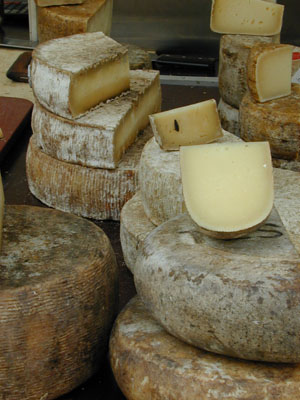
Cheese
Photo by Alex Anlicker


In order to make any cheese you need the proper starters.  These are natural milk bacteria that eat the lactose in the milk and produce lactic acid that curdles the cheese and gives each one its distinctive flavor. 

Otto Bismarck the 19th century chancellor of Germany one remarked that there were two processes that people should not watch, the making of sausage, and the passing of laws.  He might just as well have included cheese making in his diatribe.  To make cheese you have to have bacteria and mold too they give the cheese its character and flavor.

A cheese culture is made of milk, butter milk actually that has been inoculated with the proper bacteria from a specific cheese that will impart its flavor to the cheese you want to make.  This imparts lactic acid that will curdle the milk you are going to make into cheese.

There are good germs, and bad germs any human body contains several trillion different germs that supply many of our necessary life functions.  So it is with the bacteria and mold that forms cheese.  No matter what cheese you want to produce you must start with a cheese starter.

Cheese making has been around for a long while as an ancient practice with many different kinds of cheese recognized and handed down from the past.  Before the days of modern science duplicating cheeses was hit or miss at best.  Today some of the uncertainties have been taken out of cheesemaking, but not all there are still surprises.  Most batches of cheese work well however, every once in a while a batch can go bad.

One of the biggest problems facing the old time cheesemakers was their little choice of the proper starter cultures.  When they made a good batch of cheese they kept some of the whey overnight to use in the next day’s production.  Usually this worked as the bacteria in the whey multiplied and was ready to go to work the following day.  However if some “Wild Bacteria” got into the whey it could more then likely change whatever was produced the following day with disastrous results.  Making cheese in the old times was by chance more then by art.

In modern practice however steps have been taken to remove the factor of chance from the process as much as possible, but cheesemaking is still an art even though much of the chance has been removed.  One of the processes that has removed some of this chance is the pasteurizing the milk to kill the bacteria found there.  In effect this leaves you with a blank slate to work with.  This blank slate is open to any bacteria that comes along whether it is good or bad.

The other process is the availability of commercially available “cheesemaking cultures” that are added to the pasteurized milk to start the cheesemaking process.  This is done by adding the starter culture, the rennet if the recipe calls for its use, and the mold to ripen the cheese.

Unpastuerized milk actually holds the necessary bacteria to make cheese, but if the lactic acid these bacteria exceeds the amount needed to make a specific cheese the results will be a crumbly cheese.  If there isn’t enough lactic acid it will produce a cheese that has a pasty texture.  Proper quantities of lactic acid in your cheese will also help to drive the whey from the curds.  This is a crucial step in the cheesemaking process except cheeses that are soft or unripened like cottage cheese.  The formation of lactic acid aside from helping in the curdling of the milk also helps in keeping dangerous bacteria out of the cheese.

Basically there are two different types of cultures available for use, they are:

Mesophilic startersthat work at moderate temperatures whenever the curds will be warmed to a temperature no greater then 102 degrees Fahrenheit.  These cheeses include some of our favorite cheeses like Cheddar and Gouda.

The other type of starter is Thermophilic that are heat loving cultures where the curds are heated to a temperature not to exceed 132 degrees Fahrenheit for making various Swiss and Italian cheeses.

Each basic type of starter has several subspecies one of them is designed to be used with goat milk cheese only.  This is one of the mesophilic starters.  If you are making cheese at home you can culture this using a small piece of your favorite cheese placed into buttermilk as a culture.  This is kept in a refrigerator when not being used.  You should inoculate another batch of butter milk that has been pasteurized every week.  In this way you can keep a cheese culture alive for generations much like a sour bread starter.

The thermophilic starter is cultured the same way except this time it is cultured in unflavored yogurt.  The life of this starter can be extended for generations by inoculating a fresh batch of yogurt once a week.

If in doubt you can purchase cheese starters from several sources by Googling “Cheese Starters.”

References: