Showing posts with label Chinese. Show all posts

Monday, June 18, 2012

How to make Chinese Steamed Food:


Dim sum in a Chinese Steamer
Photo by Young


Steaming Chinese food is the least invasive to the ingredients of all methods of Chinese Cooking.  This is a method of cooking with steam rather then by boiling water.  Steam is capable of cooking any food.  It starts with a wok full of boiling water and a set of nifty Chinese steamers.  These are stacking circular baskets made of bamboo or stainless steel that are available in most kitchen supply stores or Chinese supermarkets.  They have woven bamboo bottoms to allow the steam to pass through.  It is important though to place a paper towel over their bottoms so that the food will not stick to the bamboo.  Steamed food whether it is vegetable, fruit, fish or meat is tender and because it is steamed retains most of its nutrients.  Steaming can be used on portions of meals or can be made to create an entire meal.

As in all techniques of Chinese cooking it is important that you segregate the ingredients by density placing the more dense ingredients at the bottom of a stack of steamers.  At the same time the ingredients have to be cut into uniform bite sized pieces so that they will cook evenly.

Some modern micro-wave ovens include a way to cook food by steaming providing a separate vessel to hold the water so that the water never comes into contact with the food only steam.  This technique is perfectly suited to the traditional Chinese steaming and may be substituted in its place.  The food that is steamed gives the dishes a moist texture, and for the health conscious there is no oil involved giving added calories.

It is also the simplest technique to master as it is almost impossible to either overcook or burn the ingredients when steaming them.  Using the steaming method also gives a more nutritious food because the vitamins and minerals are not leached away as they are by boiling the food as is common with Western cooking methods.  Steaming reduces vitamin C by 15% whereas boiling will reduce it by 25%.  All of the other nutrients are reduced by the same amount whatever method is used for cooking.  The only real disadvantage to steaming is that it is the least efficient of any of the cooking methods because most of the energy is lost to the low-efficient water that is making steam.

In Western cooking the steaming technique is usually reserved for vegetables whereas in Chinese cooking it is usually the fish, shellfish or meat that is steamed.  A steamed meat dish in most Chinese restaurants is a rarity though because it is more efficient to stir fry them, besides that the Westerners won’t know the difference.

How to do Chinese Deep Fry


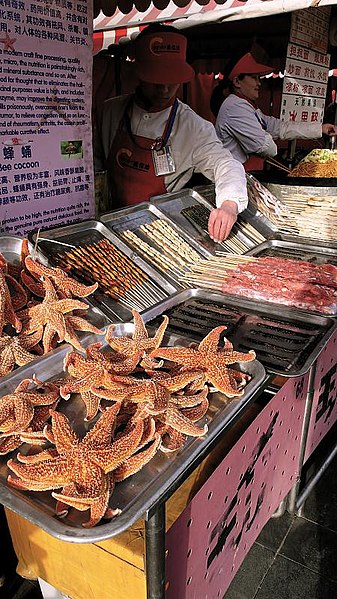
Deep fried starfish
Photo by Damnblast


The Chinese recognize two different deep frying techniques in one technique they are frying the ingredients directly.  In the other technique they are frying the ingredients with batter.  The second technique is the one that is most commonly used.  This is how the Chinese do their deep frying most effectively.

Although it is quite alright to use a modern deep fryer if you are preparing a large meal, but traditionally the Chinese have used a wok for their deep frying.  Most of the time the Chinese use peanut oil for their deep frying and any other vegetable oil that is capable of taking heat between 350 and 375°F without smoking is acceptable.  This can be done with a deep frying thermometer that is available at a kitchen supply shop that will attach to the side of your wok.  Put enough oil in a wok to fill it within 2 inches of the rim.  Maintain the heat and slide the ingredients into the oil without making it splash.  It is a good idea to use cooking chopsticks for handling the ingredients when they are in a deep fryer.  When it is finished removed from the oil with a strainer and set it aside on a paper towel to drain off the excess oil.  Then serve!

1.  Be sure that all the ingredients are cut up into bite sized pieces and are all close to the same thickness that you are deep frying.  If the sizes of the pieces are not uniform some pieces will be overcooked and others undercooked.  This may even extend to the color of pieces that will be of different colors on a piece by piece basis.

2.  You should marinate all the pieces of the batter before frying.  This will enhance the taste and the aroma of your deep frying.

3.  Keep your oil temperature between 350 and 375°F.  The temperature of the oil will vary somewhat according to what you are cooking.  Some of the pieces that do not cook through the first time will have to be re-cooked. (See number four below.)  Some things are more easily cooked than others for the ones that are easily cooked all you have to do is to maintain a high heat.  If your batch is too large to cook at once divide it up and cook it in smaller batches.  All of the cooked items are taken out of the deep fat with a strainer to preserve their appearance. 

4.  For ingredients that are not easily fried the first time such as poultry or fish balls it is perfectly all right to re-fry them so they are thoroughly cooked through.

As American as Apple Pie - Chop Suey:


A dish of chop suey
Photo by Gurav Vaida


There was a restaurant in Honk Kong that advertised real American Chop Suey.  To the author’s knowledge the word in Chinese probably means “leftovers” or “assorted pieces” since that was what it was originally made from in its birthplace of San Francisco, California in the 1850’s.  The 49ers were followed by gold hunters from all over the world flocked to California including many Chinese.  For the most part these were single men and very few of them knew how to cook.  Not all of the Chinese were bereft of cooking skills and those who could cook quickly set themselves up as restaurateurs.  it wasn’t too before the “round eyes” as the white gold miners were called discovered the Chinese restaurants and liked the food.  One of the problems facing the Chinese was that many of the traditional ingredients they were used too weren’t available in America, so in the best tradition of Chinese cooking they just grabbed anything that came to hand that was edible.  The net result was Chop Suey that is about as American as apple pie.  The only thing that was Chinese about it was that it was made by Chinese cooks.  Chop Suey was made for the round eye miners after the cooks had already fed their regular Chinese customers, and was traditionally made from the leftovers although the round eyes were unaware they were being served with gussied up Chinese leftovers. 

Chop Suey is translated into “mixed pieces” as that is what it is made from, but it was made mostly of makeovers.  Traditionally it could contain chicken, beef, pork, shrimp or seafood along with vegetables like cabbage and celery as well as bean sprouts.  The whole dish was bound together with a corn starch sauce that acted as a binder.  Typically Chop Suey was served on a bed of rice although occasionally it was served with fried noodles when it became an American-Chinese dish called Chow Mein.

Aside from America Chop Suey is eaten in many other parts of the world; Canada is one of these countries where a variation of American Chop Suey was developed and is termed Canadian-Chinese cuisine.  There is another variant that is eaten in India and is known an Indian-Chinese cuisine.  An even further variant of this dish was developed in the Philippines where it is called Filipino-Chinese cuisine.  In the Philippines the dish contains ‘wood ear” also called “ear of the rat”, carrots and chayote along with cabbage and sometimes bell peppers.

The actual origin of this dish appears to be the province of Guangdong from the district called “Taishen” where many of the Chinese miners in the California gold rush came from.  There are many stories telling about its invention in America including tales that it was invented by the Chinese laborers working on the Central Pacific Railroad in the 1860’s but the actual invention predated the railroad.  No matter where it was invented or where it spread all over the world where most people think it is a strictly Chinese invention; it isn’t.  Many hands worked on the development of this truly International-Chinese cuisine.

References:
Chop Suey, Wikipedia the free encyclopedia, http://en.wikipedia.org/wiki/Chop_Suey